pp. 14–23
Annexure A — Debt Review Process & Conduct Provisions
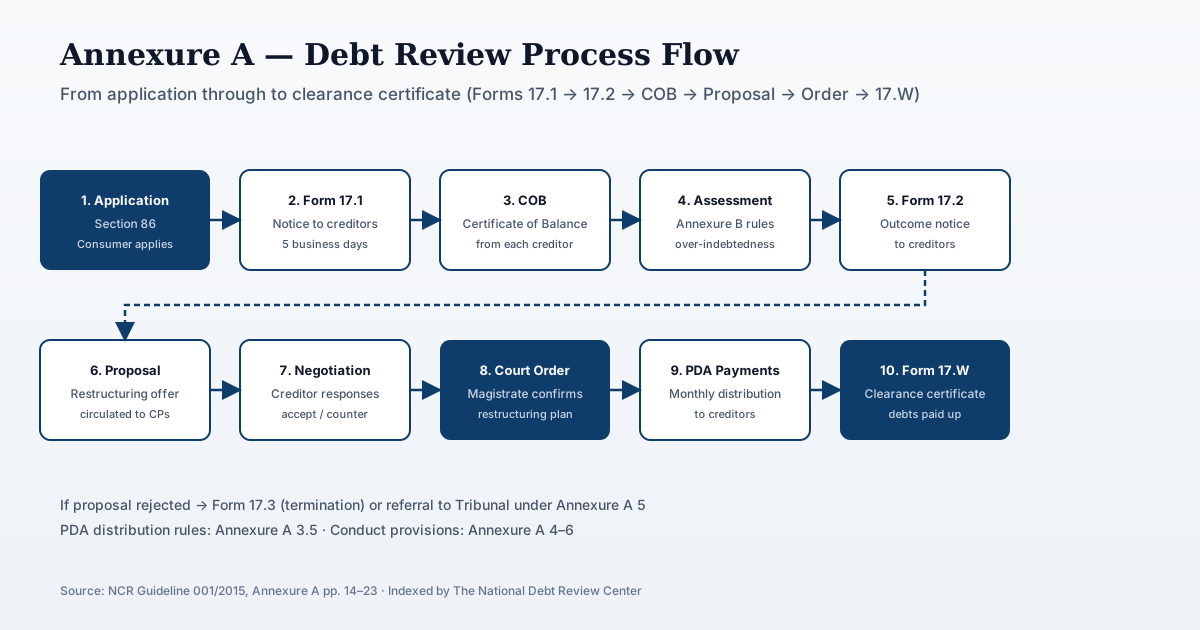
Step-by-step debt review process from Form 17.1 onwards plus expected conduct of debt counsellors, credit providers and PDAs.
Clauses in this section
- 1p.16Debt Review ProcessIntroduction The task team on debt counselling proposes a set of improved debt review process rules with a view to addressing the main blockages in the debt review process and reducing the backlog of cases under debt review. The improved process rules, which will require voluntary co-operation and give-and-take from all the parties involved, will ultimately be to the benefit of consumers, debt counselors and credit providers. The aim of the improved process rules is also to fast track those cases where there is potential to facilitate the repayment of debt to such an extent that the consumer can resume normal payments in terms of the original agreement. These process rules are intended to be voluntary adopted by the credit industry as process rules under an approved Section 48 code to combat over-indebtedness as well as by debt counselors and PDA’s under an envisaged Debt Counsellor and PDA code of conduct. Nothing contained in these improved rules shall be construed as diminishing the legal rights of any party. The affordability assessment referred to in the Task Team Agreement relates to the affordability assessment conducted by the debt counsellor (as explained in annexure c). This affordability assessment should not be confused with the credit provider affordability assessment.
- 2p.16Improved debt review process rules
- 2.1p.16Form 17Form 17.1 Stage The Debt Counsellor is required to issue Form 17.1 within 5 business days after accepting the application for debt review from a consumer.
- 2.2p.16Credit Provider Information Stage
- 2.2.1p.16Within 5 business days of receiving FormWithin 5 business days of receiving Form 17.1, the Credit Provider is required to provide a Certificate of Balance (COB) in the standardized format and include on or attached to the COB consent to receive notice of delivery of notices and legal documentation by fax or email.
- 2.3p.16Affordability Assessment
- 2.3.1p.16DC should conduct an assessment in accordanceThe DC should conduct an assessment in accordance with the Affordability Assessment Guidelines to determine if the consumer is over-indebted and to determine the amount available to repay debt.
- 2.3.2p.17If no COBIf no COB is received within 5 business days, the DC may accept the information provided by the consumer as being correct to determine if the consumer is overindebted, in terms of Regulation 24(4).
- 2.3.3p.17If a COBIf a COB is received within 5 business days, the DC should use the information provided in the COB to determine if the consumer is over-indebted.
- 2.3.4p.17If the consumerIf the consumer is found by the DC not to be over-indebted or not to be legally eligible to be under debt review, the DC should reject the application and send a Form 17.2 to the Credit Providers and Credit Bureaus.
- 2.3.5p.17If the consumerIf the consumer is found by the DC to be over-indebted and legally eligible to be under debt review, the DC should, within 10 business days of receiving the COB from all credit providers, notify both the Credit Provider/s and the Credit Bureaus of that fact per Form 17.2 and provide the Credit Provider/s with a debt rearrangement proposal that includes:
- 2.3.6p.17The debt re-arrangement proposalThe debt re-arrangement proposal should include confirmation of the following:
- 2.3.7p.17DC should follow up on all unpaidThe DC should follow up on all unpaid advices received from the PDA and, where required, take steps to maintain the continuous payment as proposed in the debt re-arrangement proposal submitted to the Credit Providers.
- 2.3.8p.17DC shouldThe DC should, as part of the Affordability Assessment, verify that premiums in respect of credit-linked insurance that formed part of monthly repayment obligations under the credit agreement are maintained and included in the PDA’s payment plan.
- 2.3.9p.18The premiums for such insurance as well as other insuranceThe premiums for such insurance as well as other insurance policies forming part of the consumer’s contractual obligations under the credit agreements such as asset insurance (homes and vehicles) as well as life and household content policies should be dealt with as required expenses in the consumer’s budget.
- 2.3.10p.18On receipt of all the Credit Provider responses withinOn receipt of all the Credit Provider responses within the prescribed 10 business day period, the DC should:
- 2.3.11p.19Within 10 business days of receiving the FormWithin 10 business days of receiving the Form 17.2 accompanied by the Affordability Assessment summary and a debt re-arrangement proposal, the Credit Provider should, in writing (Which could include an agreement to reflect the terms and conditions):
- 2.4p.19Termination of Debt Review
- 2.4.1p.19Credit ProvidersCredit Providers should not terminate debt reviews where:
- 2.4.2p.19Credit ProvidersCredit Providers should take reasonable steps to verify whether payment in accordance with the debt re-arrangement proposal have been made before terminating debt review and instituting collection action. This includes obtaining written verification with the PDA and Debt Counsellor that payments have been made.
- 2.4.3p.19Credit ProvidersCredit Providers should terminate debt reviews and institute collection action where:
- 2.5p.20Legal Contestation
- 2.5.1p.20Upon receipt of the Credit Providers replies to the debtUpon receipt of the Credit Providers replies to the debt re-arrangement proposal, the DC should:
- 2.5.2p.20If consentIf consent has been obtained from all of the Credit Providers involved, the DC should apply for a Consent Order.
- 2.5.3p.20If consentIf consent has not been obtained, the DC should set the matter down as an opposed matter and the unconditional consents of those Credit Providers, if any, who have accepted the debt re-arrangement proposal should be included in the proposal to the Magistrate.
- 2.5.4p.20DC should notify all the Credit ProvidersThe DC should notify all the Credit Providers involved of the Court date within 10 business days of it having been allocated.
- 2.5.5p.20DC should limit the number of mattersThe DC should limit the number of matters contested through the Courts by:
- 2.5.6p.21The Credit ProviderThe Credit Provider should:
- 3p.21Conduct provisions
- 3.1p.21The task team
- 3.1.1p.21With the parties, identified a number of areas in whichWith the parties, identified a number of areas in which the policies or behavior of certain of the parties need to be changed in order for the debt counseling process to operate more effectively.
- 3.2p.21With a view to improving
- 3.2.1p.21Upon the effectiveness and credibility of the debt counselingUpon the effectiveness and credibility of the debt counseling process, the task team recommends that the following change be brought about:
- 3.3p.21Suggested conduct of debt counselors
- 3.3.1p.21Debt CounsellorsDebt Counsellors should not encourage debt stressed consumers to enter the debt review process with promises of payment holidays or other similar inducements;
- 3.3.2p.21Debt CounsellorsDebt Counsellors should provide potentially debt stressed consumers with an information brochure that spells out the eligibility requirements, benefits and consequences of debt counseling and other alternatives available to them before taking them on as clients;
- 3.3.3p.21Debt CounsellorsDebt Counsellors should not take on as clients, persons who have no money available for repayment or no reasonable prospect of finding money to commence the repayment of debt.
- 3.3.4p.21Debt CounsellorsDebt Counsellors should take care in assuring that the full and correct particulars of consumers are obtained and relayed to credit providers
- 3.3.5p.21Debt CounsellorsDebt Counsellors should make sure that they perform all the steps required of them (including the requirements under the improved debt review process rules) within the legislated or agreed time frames and that they procure debit order mandates for payments to be collected by PDA’s wherever possible.
- 3.3.6p.22Debt CounsellorsDebt Counsellors should make sure that they continue to assist the consumer under debt review to make sure finalization in Court and to make sure that monthly payments are met as per the Court Order. Debt Counsellors should make sure that the correct Credit Provider account details into which payments must be made are ascertained and provided to the PDAs.
- 3.4p.22Suggested conduct by Credit Providers
- 3.4.1p.22Credit ProvidersCredit Providers should improve the administrative co-operation with debt counsellors in order to speed up the finalization of proposals, by issuing specific policies and procedures in this regard.
- 3.4.2p.22Credit ProvidersCredit Providers should implement formal policies on compliance with debt review provisions in the Act as well as any process and/or debt restructuring rules adopted under a section 48 code to combat over-indebtedness.
- 3.4.3p.22Credit ProvidersCredit Providers should implement effective policies and procedures on the cancellation of existing debt orders and stop orders on the duly authorized instruction of the consumer.
- 3.4.4p.22Credit ProvidersCredit Providers should proceed to termination and legal enforcement action when legally justified and in line with the provisions of the Act as well as any process and/or debt restructuring rules adopted under a section 48 code to combat overindebtedness.
- 3.4.5p.22Credit ProvidersCredit Providers should formalize the mandates of external law firms which deal with debt counseling applications on behalf of the credit provider in order to make sure that matters are to be opposed only on material procedural and/or substantive grounds.
- 3.4.6p.22Credit ProvidersCredit Providers must have a central unit/point of contact with an appropriate mandate to manage the engagement with a particular client who has applied for debt review via the appointed Debt Counselor.
- 3.4.8p.22Credit ProvidersCredit Providers must establish formal policies on the trade-off of competing claims between different products in line with national debt re-arrangement guidelines issued by the NCR (in terms of the Act) as well as any industry agreed debt re-arrangement rules under a section 48 code.
- 3.5p.23Suggested conduct by payment distribution
- 3.5.1p.23PDAs should make sure that they verifyPDAs should make sure that they verify the validity of account details to which payments are to be made.
- 3.5.2p.23PDAs should make sure that they capture allPDAs should make sure that they capture all information provided by debt counsellors correctly.
- 3.5.3p.23PDAs should make sure that all the partiesPDAs should make sure that all the parties are informed of the details of payments made.
- 3.5.4p.23PDAs should submit monthly statements to consumersPDAs should submit monthly statements to consumers reflecting collections and distribution details.
- 3.5.5p.23PDAs should make sure that payments are madePDAs should make sure that payments are made expeditiously.
- 4p.23Compliance, Reporting and EnforcementCompliance, Reporting and Enforcement The task team has up to now relied upon anecdotal information, unsupported by statistical information or sufficient details regarding specific transgressions, regarding the undesirable practices of the role-players involved. It accepts that part of the solution to the current problems lies in making sure that such practices are identified and curbed. All the role-player groups identified in Paragraph 3 above are requested to make sure that they are not guilty of the conduct referred to in that Paragraph 3 or to take corrective measures immediately if they are and to commit their full support to the proposed codes of conduct.
Based on NCR Guideline 001/2015. Indexed and published by The National Debt Review Center.