pp. 24–53
Annexure B — Debt Review Assessment Guidelines
Guidelines for assessing a consumer's financial position, declaring over-indebtedness, and structuring affordable repayment proposals.
Clauses in this section
- 1.1p.26The purpose of the Affordability Assessment of the consumerThe purpose of the Affordability Assessment of the consumer is important for the followingreasons:
- 1.2p.26When the determination in terms of SectionWhen the determination in terms of Section 79 is made, the Debt Counsellors should take into account Section 79(3) which provides that the value of:
- 1.3p.27This assessment of the consumer’s financial positionThis assessment of the consumer’s financial position is an important step in the Debt Counselling process for two reasons:
- 1.4p.27It is therefore required that the affordability assessmentIt is therefore required that the affordability assessment complies with guidelines set out in this document, which is based on the following broad principles:
- 1.5p.27Before a repayment proposal can be completed, an AffordabilityBefore a repayment proposal can be completed, an Affordability Assessment should be conducted by the Debt Counsellor. In this process it is recommended that Debt Counsellors consider the guidelines in this document. When this process is followed the following can be achieved:
- 2.1p.28Elegibility to apply for debt counsellingElegibility to apply for debt counselling A consumer as defined in the NCA may apply for Debt Counselling in terms of Section 86 of the NCA. When an application from a consumer is received the Debt Counsellor should consider the following; Section 3(g) of the NCA states the following: “providing for a consistent and harmonized system of debt restructuring, enforcement and judgement, which places priority on the eventual satisfaction of all responsible consumers obligations under credit agreements” Over indebtness relates to existing inabilities to satisfy obligations and future inability. This means that Debt Counsellors should access the ability to repay the debt from future income. Where consumers have no income or no prospect of receiving income to repay their debt, Debt Counsellors should refrain from accepting such an application. This assessment is made by Debt Counsellors in terms of Section 79(1) as the information exists at that point in time. Some consumers might apply for Debt Counselling because of retrenchment or temporally reduction in income and those consumers should not be excluded. In such cases the Debt Counsellor might recommend postponement of payments during a specified period to a Magistrate Court as set out in Section 86 and 87 of the NCA. The important principal to be considered is the ability of the consumer to resume payments in the near future. In the retrenchment example the consumer should find alternative employment in a reasonable period. In practical terms the following issues should be considered at the point of application:
- 2.2p.29Marital StatusMarital Status
- 2.3p.30To make sure that not all debtTo make sure that not all debt is being passed to one of the parties whilst the couple continues to live well off a substantial surplus from the other partner. Include all income When a consumer applies for Debt Counselling all the consumer’s income has to be included. This is defined in Section 78(3) as follows: “In this part, “financial means, prospects and obligations’, with respect to a consumer or prospective consumer, includes:
- 2.4p.30Temporary Loss of IncomeTemporary Loss of Income In some cases a consumer could not necessarily be over-indebted but could be experiencing or is likely to experience difficulty in satisfying all the monthly obligations under credit agreements in a timely manner. This is often the case when one of the following events occurs:
- 3p.31Determination of Gross IncomeAssets The consumer should be encouraged to complete a list of assets on application for Debt Counselling (Form 16). The following information is important in this regard:
- 3.1p.31The Debt Counsellor
- 3.1.1p.32If the consumerIf the consumer has a cash investment such as a money market account or term investment, Debt Counsellors should encourage the consumer to use the proceeds of this investment to reduce debt. This is in line with Section 78(3) of the NCA.
- 3.1.2p.32If the consumerIf the consumer has quoted shares, Debt Counsellors should encourage the consumer to sell the shares and to use this to reduce debt. This is in line with Section 78(3) of the NCA.
- 3.1.3p.32In some cases consumersIn some cases consumers have rights to share options with their employer. Where this is the case the Debt Counsellors should establish when these option(s) mature and the proceeds should be used to reduce debt at that point in time. In most cases it might be difficult to determine after tax benefit up front.
- 3.1.4p.32In some cases consumersIn some cases consumers have luxury assets such as ski boats, quads, and other “toys”. These assets could be sold and the proceeds used to reduce debt. Where those assets are financed, the proceeds should be used to repay the debt and should there be a shortfall, this should be included in the debt review and repaid in line with the other debt.
- 3.1.5p.32Should the proceeds be less than the settlement amountShould the proceeds be less than the settlement amount of the debt, this shortfall should be included in the debt review as unsecured debt. Any excess should be used to reduce other debt.
- 3.1.6p.32In the case of a second home, investment properties or holidayIn the case of a second home, investment properties or holiday homes, the Debt Counsellor should consider exploring the possibility with the consumer of selling the assets to reduce debt. Where second properties are not sold it is recommended that the Debt Counsellor provide reasons to Credit Providers and the Magistrate Court.
- 3.1.7p.32Vehicles not used by the consumer or his or her dependants (iVehicles not used by the consumer or his or her dependants (i.e. student) could be sold and the proceeds used to reduce debt.
- 3.1.8p.32In the case where the consumerIn the case where the consumer has a luxury home or vehicle, Debt Counsellors should investigate the possibility to sell these assets and to downgrade. This is not always possible for the following reasons:
- 3.2p.33Short Term insurance on assets financedShort Term insurance on assets financed Where an asset has been financed by the Credit Provider, it is often a requirement that a complete short term insurance³ is maintained. In practice many consumers have cancelled their short term insurance long before they have applied for Debt Counselling notwithstanding the contractual obligation to maintain a short term insurance policy to protect the assets financed. The absence of such a policy not only increased the risk for the Credit Provider, but it increases the risk for the consumer who has applied for Debt Counselling. Should the consumer be involved in an accident or if the vehicle is stolen and not covered it places the over-indebted consumer in a worse financial position. It is therefore in the interest of the consumer that insurance of assets be examined during the Affordability Assessment. If Debt Counsellors make sure that insurance is in place this could improve the probability that the debt review will be successful and this will make sure that the consumer complies with the terms of the agreement with Credit Providers. Debt Counsellors should verify the need for insurance on debt included in Debt Counselling. This is normally a contractual obligation. The premium for insurance should be included in the proposed budget of the consumer and confirmation of insurance should be forwarded to the relevant Credit Provider. In addition, it is recommended that the amount required for such insurance should be collected by the appointed Payment Distribution Agency and paid over to the Credit Providers or Service Providers. Debt Counsellors are required to monitor monthly payments of these amounts. Any increases of the amount required for this insurance should be catered for and should be included in the annual review conducted by the Debt Counsellor.
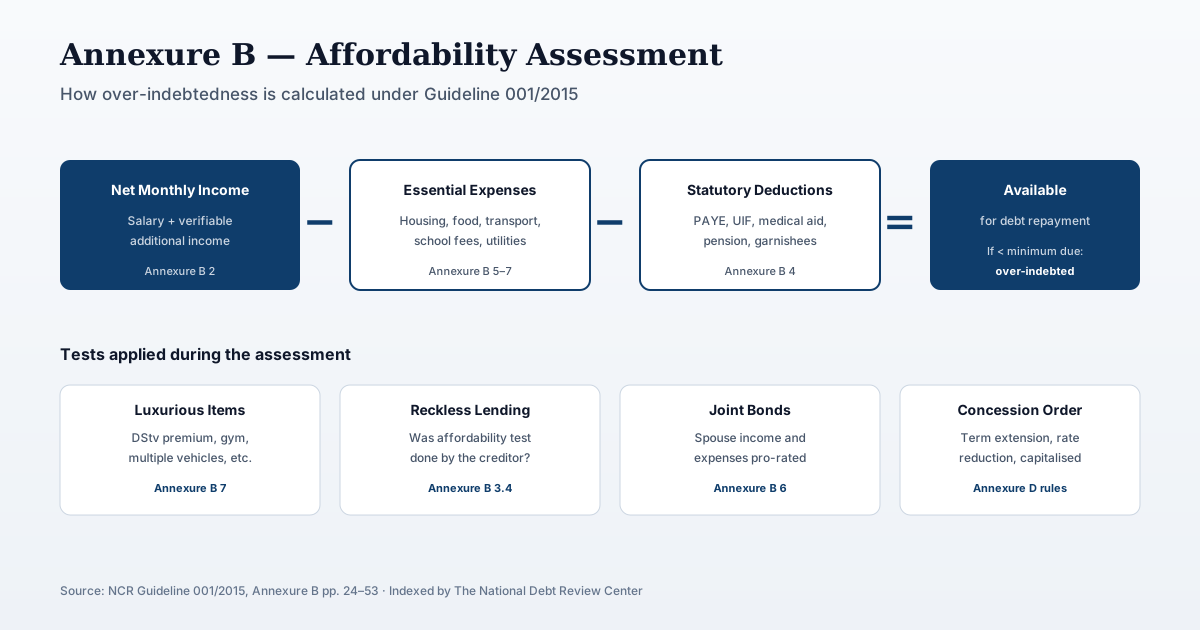
- 3.3p.34Joint Bonds Where the consumer who appliesJoint Bonds Where the consumer who applies for Debt Counselling has a joint bond with another consumer the following is important:
- 3.4p.35Reckless LendingReckless Lending The Amendments of the NCA extend the power of the NCT to consider and pronounce reckless agreements. This amendment may result in an amendment of the reckless lending process in this annexure. A review will be conducted as soon as detailed process information is available. Debt Counsellors are obliged and encouraged, as part of the financial assessment, to identify reckless lending by Credit Providers and if such finding is made issue a proposal to the Magistrate Court to make an order, as per Section 86(7)(c)(i) of the NCA, that one or more of the consumer’s credit agreements be declared reckless. The criteria to determine whether a credit agreement is reckless or not is set out in Section 80 of the NCA. Section 80(2) provides that: “When a determination is to be made whether a credit agreement is reckless or not, the person making that determination must apply the criteria set out in subsection
- 4p.36Determination of Nett Income
- 4.1p.36On making an effective assessmentOn making an effective assessment it is important to make sure that the consumer’s NETT income is properly assessed. NETT income is determined by taking the gross income, adjusted for irregular income, less statutory deductions, less mandatory employer deductions. Income not derived from main employment must be added to this:
- 4.2p.37The consumer(s)The consumer(s) should be requested to make the following available when NETT income is determined:
- 4.3p.37Gross payGross pay is the total of all pay plus the total of employer benefits. Weekly wages are to be converted to a monthly income figure for calculation purposes (to submit a monthly income & expenditure statement).
- 4.4p.37Deductions for irregular incomeDeductions for irregular income
- 4.5p.37Statutory deductions or compulsory deductionsStatutory deductions or compulsory deductions are all of those deductions that an employer must make as ordered by a court or legislation. These include:
- 4.6p.38Employer deductionsEmployer deductions are deductions made by an employer for services that the employee must subscribe to as a condition of employment. This include
- 4.7p.38Use the following guidelines in respect of other incomeUse the following guidelines in respect of other income:
- 5p.38Determination of Reasonable Living ExpensesMinimum Amount of Nett Income Available for Debt Repayments Consumers who apply for debt review are often reluctant to reduce their lifestyle resulting in a small unrealistic amount being available for debt repayment. The level of over indebtedness (after reckless lending has been ruled out) also has an effect on the amount available for debt repayments. Where this is the case the proposed repayments offered are very low and proposed term is unrealistically long. Important Note: Debt Counsellors should use this guideline to determine the minimum available amount for debt repayment. Consumers should be encouraged by Debt Counsellors to use a higher percentage of after tax income or household income to repay debt.
- 5.1p.39The purpose of setting minimum criteriaThe purpose of setting minimum criteria is the following:
- 5.2p.39The proposed guidelines in the table below take into accountThe proposed guidelines in the table below take into account that the spending patterns of consumers are influenced by the level of own income, household income, dependants and required expenses. The percentages that are tabulated below are indicative only and are based on the After Tax Income or household income specified in range bands. The aim of this guideline is for the Debt Counsellors to use this as a guideline to determine the minimum level of nett income that is available for debt repayments.
- 5.3p.39Spending GuidelinesSpending Guidelines This spending guideline is based on after tax income, before any other deductions, of the applicant(s) subject to Note 1, 2 and 3 below for specific application to the consumer’s position at that point in time. Percentage of household income to be made available as a minimum for After Tax Income repayment of debt R 0 – R 2 000 23% to 45% R 2 001 – R 5 000 32% to 47% R 5001 – R 10 000 35% to 49% R 10 001 – R 20 000 37% to 51% R 20 001 – R 40 000 40% to 53% R 40 001 – R 60 000 45% to 55% R 60 0001 + 45% to 58% Notes:
- 6p.40Determination of Available IncomeReview of Spending Patterns Once the income of the consumer has been determined it is time to review spending items that can be reduced. The purpose of this process is to make sure that a sustainable budget has been created for the consumer. This means the inclusion of required expenditure and the reduction or elimination of luxury expenses. This will require the consumer to implement certain sacrifices to make sure that the budget of the consumer is realistic, sustainable and defendable in a Magistrate Court. It is important to note that the Debt Counsellor is fulfilling a statutory obligation and for this reason care should be taken to make sure that the Debt Counsellor has applied his or her mind to the financial assessment of the consumer’s financial position. Debt Counsellors could be requested by a Court to substantiate the Affordability Assessment and the determination of the amount available for debt repayment. Debt Counsellors should be able to explain and defend their financial assessment. It is however important to note that the spending patterns of consumers will in most cases be different. The reason for this is that consumers have different needs and requirements. For instance some consumers will spend more on the education of their children but will spend less on food. Others might decide to spend money on their DSTV but decrease spending on a different item. What is important to Debt Counsellors is to make sure that overall expenditure is reasonable and defendable. Many Credit Providers and Magistrates will have different interpretations of individual items. For instance some might argue that smoking should be stopped while others might consider even reasonable telephone expenditure as unreasonable. In the final analysis, the proposed budget can only be constructed if all expenditure is assessed and the final outcome is reasonable. To assist Debt Counsellors the following guidelines should be used in the analysis of required non-required and luxurious expenditure. 7. Identifying Various Expenses as Required, Non-Required and Luxurious, and how to deal with each of these categories
- 7.1p.41Required Expenses
- 7.1.1p.41Rental, where no bondRental, where no bond is in place, should be reasonable considering the consumer’s circumstances.
- 7.1.2p.41Debt Counsellors could ask the following questionsDebt Counsellors could ask the following questions:
- 7.1.3p.41Groceries (food, toiletries, cleaning materials) - groceriesGroceries (food, toiletries, cleaning materials) - groceries to be in line with size of the family and dietary requirements.
- 7.1.4p.41Water & Lights (if not part of rental)Water & Lights (if not part of rental).
- 7.1.5p.41Rates & Taxes (if consumerRates & Taxes (if consumer is liable).
- 7.1.6p.41Body corporate leviesBody corporate levies.
- 7.1.7p.41Domestic workers depending on circumstances, eDomestic workers depending on circumstances, e.g. child care.
- 7.1.8p.41EducationEducation. This could include day care, crèche, Public/Model C Schools, Private Schools or tertiary education in SA. If Private Schools are used the Debt Counsellor is encouraged to explore the possibility of less expensive schooling. In some cases the consumer might select to reduce expenses in other categories but not schooling. Where this is the case consumer choice should be considered.
- 7.1.9p.41Consumers may apply for subsidised school feesConsumers may apply for subsidised school fees or exemption of school fees from the school’s Governing Body when in need. This is normally done annually before 28 February.
- 7.1.10p.41Existing tertiary educationExisting tertiary education should be allowed to continue - even if a student obtains part time income to supplement his own studies.
- 7.1.11p.41Transport (public transport and/or reasonable running expensesTransport (public transport and/or reasonable running expenses of vehicle including fuel & maintenance).
- 7.1.12p.42Telkom phone or cellular phones or internet access withinTelkom phone or cellular phones or internet access within a reasonable amount.
- 7.1.13p.42Multiple cellular phonesMultiple cellular phones are not required (indicate if contracts) and consumers should be encouraged to switch to less expensive contracts or pre-paid when contracts expire.
- 7.1.14p.42Encourage consumer to set limits on cellular phone contractsEncourage consumer to set limits on cellular phone contracts.
- 7.1.15p.42Maintenance that should be paidMaintenance that should be paid over to dependants as per the Court Order. Obtain a copy of the Court Order to verify the amount. Where an oral amount has been agreed, without a Court Order being obtained, it is good practice to obtain confirmation from the paying party or regular payments must be evident on the applicants bank statements.
- 7.1.16p.42Utilities but encourage the consumer to reduce usage where usageUtilities but encourage the consumer to reduce usage where usage is high.
- 7.1.17p.42Clothing and shoes within reason, higher amount for growingClothing and shoes within reason, higher amount for growing children.
- 7.1.18p.42Chronic medication (obtain proof that not covered by medical aidChronic medication (obtain proof that not covered by medical aid / see whether generics are available at a reduced cost).
- 7.1.19p.42Support of relatives with valid reasonsSupport of relatives with valid reasons.
- 7.1.20p.42Financial Services - Debt CounsellorsFinancial Services - Debt Counsellors may not recommend any reductions in medical aid, insurance or assurance. Where an expense appears exorbitant the Debt Counsellor should refer the consumer to a FAIS approved financial planner. If the Debt Counsellor gives advice in this regard without being appropriately registered with the Financial Services Board, he may face prosecution for contravening FAIS.
- 7.1.21p.42Medical Aid - the consumerMedical Aid - the consumer should be appropriately covered in relation to his income and family needs.
- 7.1.22p.42Life AssuranceLife Assurance - should be reasonable. Sometimes an insurance policy can be suspended for a period.
- 7.1.23p.42Credit Life - money that a consumer pays to an insurance companyCredit Life - money that a consumer pays to an insurance company that will cover certain outstanding debts in the event of the account holder’s disability or death. If payment is stopped the cover will lapse. This expense is usually linked to consumer’s debt payment. Be sure to separate it from the installment amount when perusing the debt.
- 7.1.24p.42Insurance - money paid to an insurance company to protectInsurance - money paid to an insurance company to protect a person against the risk of their property being damaged or destroyed. If payment is stopped the protection will lapse. As a consumer under Debt Counselling will most likely be unable to replace their assets in the event of their loss, adequate insurance should be provided for:
- 7.1.25p.43Anything else that can be regarded as requiredAnything else that can be regarded as required under the consumer’s unique circumstances. The Debt Counsellor must make sure that all required expenses are, in the first instance required and in the second instance reasonable.
- 7.2p.43Non-Required ExpensesNon required Expenses Non required expense are those expenses paid by consumers that are not absolutely necessary, but that are none the less an important part of daily existence. These will include:
- 7.2.1p.43Domestic worker/s (unlessDomestic worker/s (unless this is the substitute for day care / crèche / after care facilities).
- 7.2.2p.43Garden servicesGarden services.
- 7.2.3p.43Alcoholic beveragesAlcoholic beverages. Reduce but not suspend.
- 7.2.4p.43Tobacco/cigarettesTobacco/cigarettes. Reduce but not suspend.
- 7.2.5p.43EntertainmentEntertainment. Reduce substantially.
- 7.2.6p.43DSTV or MNet - consider downscaling at the end of the contractDSTV or MNet - consider downscaling at the end of the contract. Remember that most other entertainment has been reduced substantially and the consumer could only be left with DSTV.
- 7.2.7p.43Recreation / club membershipsRecreation / club memberships. Depending on contract - terminate.
- 7.2.8p.43Children’s pocket moneyChildren’s pocket money. Reduce within reason but not suspend.
- 7.2.9p.43Tithes / donationsTithes / donations. Reduce but not suspend.
- 7.2.10p.43Cosmetic services / beautician / pampering sessionsCosmetic services / beautician / pampering sessions. Reduce but not suspend.
- 7.2.11p.43Some allowanceSome allowance must be made for this class of expenditure, as long as the amount allocated is reasonable considering the circumstances of the consumer. As a minimum requirement this does not mean that Debt Counsellors cannot allow non required expenses. If used in moderation some of the items could be included in the budget on condition that the total spending on required and non-required items is reasonable and defendable.
- 7.3p.44Luxurious Items
- 7.3.1p.44Multiple propertiesMultiple properties. Where this is the case the consumer should be requested to sell the second property. It could be that a shortfall is generated when the second property is sold and this shortfall should be included in the debt review for repayment in line with other unsecured debt.
- 7.3.2p.44If a propertyIf a property is being rented out, the rental income less expenses, incurred to maintain the property, should be allocated to the repayment of the bond on that particular property. Unless the rental covers the bond repayment serious consideration should be given to sell this property to reduce overall indebtedness. It could be that a shortfall be generated when the second property is sold and this shortfall should be included in the debt review for repayment in line with the other debt.
- 7.3.3p.44Boat, Jet Ski, sun bed and other “toy” itemsBoat, Jet Ski, sun bed and other “toy” items. Debt Counsellors should consider recommending the sale of these assets to reduce debt.
- 7.3.4p.44Luxury vehicles used as the only means of transport by consumerLuxury vehicles used as the only means of transport by consumer. Debt Counsellors could consider advising the client to sell the vehicle if this is financially viable and finance is available to purchase a less expensive vehicle.
- 7.3.5p.44Luxury vehicles not used by the consumer on a daily basisLuxury vehicles not used by the consumer on a daily basis. Debt Counsellors should explore the possibility, depending on circumstances and minimum requirements of the household; advising the client to sell these vehicles at a profit or break even position.
- 7.3.6p.44Holiday clubsHoliday clubs. In most cases it is difficult to sell but consideration should be given to sell or at lease suspend the ongoing expenditure on holiday clubs.
- 7.3.7p.44GamblingGambling.
- 8p.44Restructuring ProposalKnowing when Expenses need to be Revised Establish the expenses that the consumer has, taking into account their unique circumstances, living arrangements, dependants and income group. Include all required expenses and apply careful consideration to non-required and luxurious items. The Debt Counsellor should assist the consumer in re-working the income & expenditure and reach mutual agreement on where expenses can be reduced / controlled.
- 8.1p.45Establish whether thereEstablish whether there is any equity in assets and see whether any assets can be sold to reduce / repay some of the debt.
- 8.2p.45Any available cash resources, bonuses or thirteenth chequesAny available cash resources, bonuses or thirteenth cheques should also be applied in reduction of debts.
- 8.3p.45Consider to downsize from an expensive luxurious vehicleConsider to downsize from an expensive luxurious vehicle. Credit Providers can be approached with a request to“ consolidate down”. Downsizing can only be implemented if Credit Providers are agreeable to provide a consolidation loan to finance a smaller vehicle. Most Credit Providers will not at present consider such loans as consolidation loans or loans to downsize due to the fact that based on their interpretation this lending could be seen as reckless. If downsizing is an option the consumer will be liable for the shortfall on the vehicle handed back on a voluntary basis.
- 8.4p.45If a fixed property (house)If a fixed property (house) is to be sold to ease financial burden, the existing bond should form part of the initial repayment proposal, together with details of the offer to purchase and approved buyer confirmation as and when this is available. When the transaction is complete, a revised proposal is required. Consumers are to be encouraged to take the best offer because the cost of interest while the consumer waits for a better offer is most often more than the extra money realised from the better offer. If there is a shortfall on the home loan after the property has been sold, then this shortfall must be included in the proposal as unsecured debt. In such instances bond holders may waive the early termination fee.
- 8.5p.45Consider whether the consumerConsider whether the consumer is able to find part time income or some other means to supplement income, if expenses cannot be reduced.
- 8.6p.45Make sure that all expenditureMake sure that all expenditure is realistic in terms of size of household, number of dependants and income bracket.
- 8.7p.45If revised living expenses exceed income then the consumerIf revised living expenses exceed income then the consumer cannot be helped by the Debt Counsellor. Expenditure must be further revised or the Debt Counsellor may reject the application.
- 8.8p.45If the consumer’s revised living expensesIf the consumer’s revised living expenses are greater than his income and his assets are less than his liabilities, he is insolvent and could consider applying for sequestration, providing that the assets owned could assure advantage to concurrent creditors. Refer the consumer for professional advice to any attorney. The overall aim of the financial assessment is to assist the consumer to scale down and in so doing make sure that the amount available for debt repayments is maximized without being unrealistic. When such a budget is drawn up, Debt Counsellors should take into account that in most cases this is a long term budget. For this reason the budget should include an amount to be saved in a contingency account. This amount, which should not exceed 10 percent of the amount available, should ideally be saved in a separate account and can even be included in the amount paid over by the PDA. It is recommended that the 10 percent guideline be implemented for low income earners and that this percentage is reduced for high income earners. Debt Counsellors are encouraged to convince consumers to save the amount on a monthly basis for unforeseen or seasonal expenditure. For example annual school fees, vehicle maintenance, house maintenance or emergency situations.
- 9p.46Broad Guideline forSpending PatternsBroad Guideline forSpending Patterns To assist Debt Counsellors the following broad guidelines can be used to measure spending patterns of consumers. It must be pointed out that these guidelines are general guidelines which could be used to identify excessive spending in certain categories and to motivate a reduction in lifestyle to the consumer.
- 10p.46Annual ReviewAnnual Review Debt Counsellors should review the Affordability Assessment on an annual basis. When this assessment is completed the following should be reviewed:
- 11p.47Recognising and Dealing with Addictive BehavioursRecognising and Dealing with Addictive Behaviours Addictive behaviours are habits that a consumer has where they indulge in expenditures that they cannot afford but nonetheless cannot stop for one reason or another. Addiction falls into two types, physical and psychological. Very often a person may have both types pertaining to a specific addiction. when there is one addiction there is often another. Debt Counsellors should always be on the lookout for addictive behaviours and when identified refer the consumer for professional assistance. Gambling may be one such addiction. It is important to understand gambling. Gamblers can be classified in 3 broad groups:
- 12p.47Conclusion Consumers are over-indebted if too muchConclusion Consumers are over-indebted if too much credit has been extended/taken or there is a change in personal circumstances beyond their control (e.g. unemployment, retrenchment, divorce, serious illness resulting in unusually high medical expenses, and death of spouse etc), resulting in the consumer being unable to fulfill his debt obligations in a timely manner. The purpose of the abovementioned minimum criteria is to make sure that the consumer’s financial assessment is fair on all parties involved. For the consumer the budget should reduce lifestyle within reason. For Credit Providers the budget should be drawn up to make sure that the maximum possible amount has been made available. If this process is followed both the consumer and Credit Provider should accept the outcome.
- 13p.48Annexure b1 – Affordability Assessment Process StepsAnnexure b1 – Affordability Assessment Process Steps 1. Affordability Assessment 2. Interview with Consumer 3. Verify Consumer Details 4. Verify Debt 5. Verify Income 6. Check for Reckless Lending 7. Review Asset Statement 8. Revise Budget 9. Verify Short Term Insurance 10. Affordability Amount
- 14p.48Annexure b2 – Affordability Assessment Check List
- 14.1p.48Affordability AssessmentAffordability Assessment
- 14.2p.49Interview with ConsumerInterview with Consumer
- 14.3p.49Verify Consumer DetailsVerify Consumer Details
- 14.4p.49Verify DebtVerify Debt
- 14.5p.49Verify IncomeVerify Income
- 14.6p.49Check for Reckless LendingCheck for Reckless Lending
- 14.7p.49Review Asset StatementReview Asset Statement
- 14.8p.50Revise BudgetRevise Budget
- 14.9p.50Verify Short Term Insurance Required by Debt AgreementsVerify Short Term Insurance Required by Debt Agreements
- 14.10p.50Affordability AmountAffordability Amount
- 16.1p.52Check that the rates applicable to the debtCheck that the rates applicable to the debt are in line with the maximum prescribed Interest Rates and Initiation Fees as per Regulation 42 of the NCA. In determining interest and fees, note that agreements entered into before 1 June 2007 are not subject to NCA limitations and reckless lending provisions. If interest and/or fees are not in line with the guidelines, request a written explanation from the Credit Provider within 20 business days. If no reply is received or if the reply is not satisfactory, report the non compliance to the NCR for investigation and possible action. Referring this matter for investigation should not delay a recommendation of reckless lending to a Court for a ruling.
- 16.2p.52Note that contracts entered into before JuneNote that contracts entered into before June 2007 are not subject to the reckless lending rules except where the existing contract was altered after June 2007 e.g. in the case of a mortgage bond an additional loan amount was granted.
- 16.3p.52The possible reckless debt indicator needs to be completedThe possible reckless debt indicator needs to be completed for each debt. The previous monthly debt repayments need to be taken into account when the calculation is completed. The calculation should result in a consequential increase in percentage income after tax used every month to service debt repayments.
- 16.4p.52Where the monthly debt repayments exceed the maximums, as perWhere the monthly debt repayments exceed the maximums, as per the table in 5 below, that debt and all the debt approved after that date should be investigated for possible reckless lending.
- 16.5p.52Reckless Lending IndicatorReckless Lending Indicator Percentage of After Tax Income After Tax Income required to pay Monthly Debt Payments R 0 – R 2 000 TBC % R 2 001 – R 5 000 TBC % R 5 001 – R 10 000 TBC % R 10 001 – R 20 000 TBC % R 20 001 – R 40 000 TBC % R 40 001 – R 60 000 TBC % R 60 000+ TBC %
- 16.6p.53When the Reckless Debt IndicatorWhen the Reckless Debt Indicator is exceeded, follow the following steps:
Based on NCR Guideline 001/2015. Indexed and published by The National Debt Review Center.