pp. 6–13
Covering Report
Background to the Task Team, terms of reference, identified obstacles, and the recommended approach to compliance.
Clauses in this section
- 1p.8Introduction
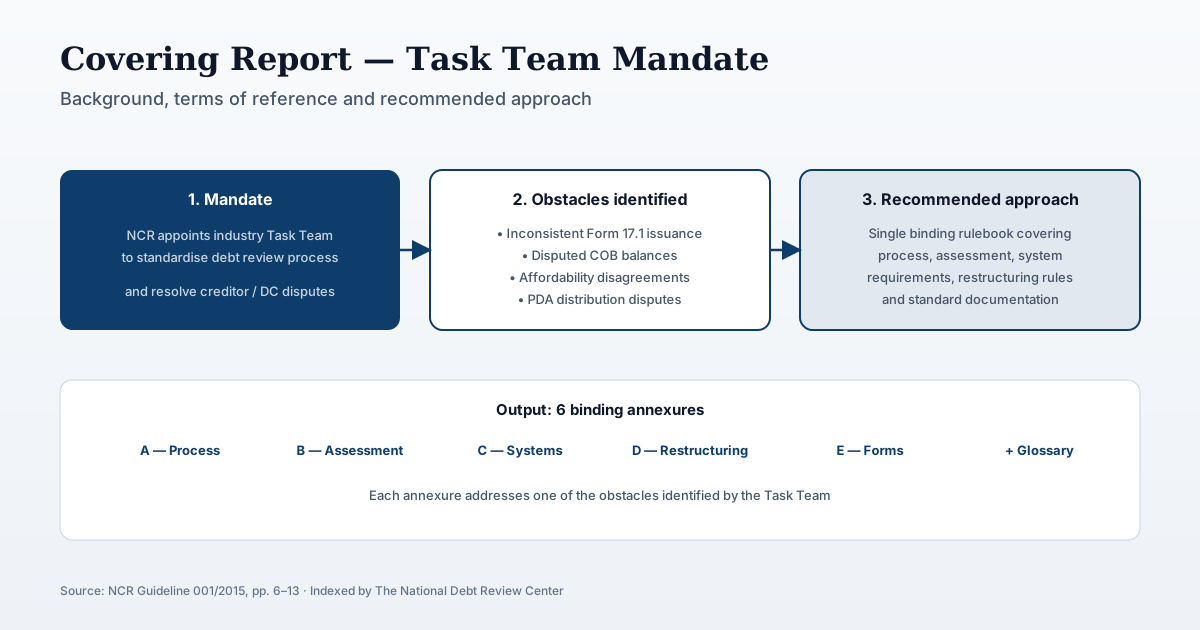
- 1.1p.8The National Credit Regulator (NCR) set up a Task TeamThe National Credit Regulator (NCR) set up a Task Team in October 2010 to identify the blockages in the debt review process under the National Credit Act and reduce the backlog of unresolved cases under debt review.
- 1.2p.8Terms of ReferenceThe Task Team’s Terms of Reference were to:-
- 1.3p.8Credit Industry Forum (CIF)The Credit Industry Forum (CIF) was established in 2013 and in early 2014 CIF reviewed the entire Task Team Agreement. All members of CIF were requested to provide written submissions for the Task Team Review and 180 submissions were received. Each submission was review by CIF and where required consultations were conducted. All members of CIF approved the revised Task Team Agreement and CIF submitted the approved Task Team agreement to the NCR to issue as Guidelines.
- 1.4p.8The aim of the Task Team Agreement remains to addressThe aim of the Task Team Agreement remains to address operational and process issues not covered in the NCA. Any Task Team Agreement issue covered by subsequent NCA Amendments will be superseded by the NCA Amendment.
- 2p.8Approach Adopted
- 2.1p.8A thorough technical analysisA thorough technical analysis was made of the process as defined in the Act at present, as well as the manner in which it is applied in practice, in order to identify the possible causes of the backlog.
- 2.2p.8Once this analysisOnce this analysis was completed, the Task Team developed proposed interventionsaimed at resolving the backlog as well as improving the success rate in resolving new applications entering the process.
- 2.3p.9Once these proposalsOnce these proposals were formulated, the Task Team embarked on an extensive consultation process with the key stakeholders in the debt review process including:
- 2.4p.9The various stakeholders made representations duringThe various stakeholders made representations during the interactive consultation meetings and some of them availed themselves of the invitation to make written submissions in response to the draft Task Team proposals.
- 2.5p.9A set of proposed enhancements of the restructuring rulesA set of proposed enhancements of the restructuring rules (Annexure E) was provided to the credit providers, with the recommendation that they consider implementing them after consultation with the other roleplayers.
- 2.6p.9While the Task TeamWhile the Task Team was able to refer to empirical studies such as that conducted by the University of Pretoria and the review of debt counsellor software systems conducted by Gobodo Inc., it has relied chiefly upon the anecdotal information and views provided by the stakeholders during consultations. Not being a commision, it did not receive testimony on oath.
- 3p.9Key Conclusions
- 3.1p.9Main obstacles identifiedMain obstacles identified The Task Team concluded that the backlogs in the debt review process at present are being caused by a complex set of factors related to:
- 3.1.1p.10Judicial system capacity constraints
- 3.1.1.1p.10Although the volume of cases processed by the MagistratesAlthough the volume of cases processed by the Magistrates Courts has increased significantly since the NCR obtained High Court Declaratory Orders in August 2009, the severe capacity constraints in the system have resulted in less than 10% of the monthly case volume being dealt with by the courts at present. Some rolls have a backlog of cases awaiting a hearing of up to two years.
- 3.1.1.2p.10Even though the NCR has implemented initiativesEven though the NCR has implemented initiatives to improve the situation such as hosting workshops with the magistrates, it is not realistic to expect that in the foreseeable future the courts will be able to deal with all the debt review cases that enter the system.
- 3.1.1.3p.10It is not to the advantage of either credit providers or oveIt is not to the advantage of either credit providers or overindebted consumers for a large number of debt review cases to drag on for years. Such a state of affairs poses a systemic risk to the financial system and is contrary to the intention of the National Credit Act of speedily getting overindebted consumers back on their feet and into the economy.
- 3.1.1.4p.10The problem of court incapacityThe problem of court incapacity is compounded by the fact that a low number of cases is being finalized on a consentual basis between credit providers and debt counsellors. There are indications that this is due to the absence of widely accepted and applied debt re-arrangement rules and a lack of confidence by debt counsellors in the National Debt Mediation Association that was created to assist consumers in arriving at settlements with credit providers.
- 3.1.2p.10Process weaknesses
- 3.1.2.1p.10The lack of standardisation of format and content of keyThe lack of standardisation of format and content of key documentation in the process:
- 3.1.2.2p.10Problems related to the receipt and distribution of paymentsProblems related to the receipt and distribution of payments by consumers:
- 3.1.3p.11Inadequate operational compliance
- 3.1.3.1p.11By debt counsellors in many instancesBy debt counsellors in many instances:
- 3.1.3.2p.11By credit providers in many instancesBy credit providers in many instances:
- 3.1.4p.12Lack of co-operation between credit providers and debt
- 3.1.4.1p.12The absenceThe absence of:
- 3.1.5p.13Possible abuse of the process by consumers
- 3.1.5.1p.13There are indications that a growing numberThere are indications that a growing number of consumers are abusing the debt counselling process and using debt counselling as an excuse for not meeting their payment obligations. It is not the intention of the Act to protect such individuals, as this behaviour is creating significant risk to mortgage banks in particular and is promoting a culture of non-payment, even amongst high income consumers.
- 3.1.5.2p.13This problemThis problem is being compounded by some debt councellors encouraging consumers to abuse the system and some credit providers failing to take legal action when it would be appropriate for them to do so.
- 4p.13Conclusion
- 4.1p.13The Task Team recommendationsThe Task Team recommendations are largely directed at voluntary, non statutory measures being put in place. The Task Team Agreement is issued by the NCR as guideline for implementation by all Credit Industry stakeholders.
- 4.2p.13Compliance to the Task Team AgreementCompliance to the Task Team Agreement will be monitored. Non-Compliance should be reported to CIF for intervention.
- 4.3p.13Should the CIF intervention not realise the requiredShould the CIF intervention not realise the required co-operation the matter will be referreed to the NCR. Annexure A: Proposed Debt Review Process Enhancements and Conduct Provisions. Annexure B: Proposed Debt Review Assessment Guidelines Annexure C: Proposed Minimum Debt Counselling System Requirements and Principles of Debt Restructuring Annexure D: Industry Agreed Consensual Debt Restructuring Rules to be deployed under the Section 48 (1) industry Code of Conduct to combat over-indebtedness. Annexure E: Standard documentation
Based on NCR Guideline 001/2015. Indexed and published by The National Debt Review Center.